> For the complete documentation index, see [llms.txt](https://docs.os.uk/more-than-maps/llms.txt). Markdown versions of documentation pages are available by appending `.md` to page URLs; this page is available as [Markdown](https://docs.os.uk/more-than-maps/data-demonstrators/topography-demonstrators/os-ngd-water-features.md).
# OS NGD Water Features
A Lightning Talk
## What are the layers in OS NGD Water Features?
There are seven feature types in the OS NGD Water Features collection: Water, Tidal Boundary, Continuous Tidal Boundary, Intertidal Line, Water Point, Water Body Catchments and River Basin Districts.
{% tabs %}
{% tab title="Water" %}
This is a set of water polygons, the same as the polygons in the Water theme in OS MasterMap Topography Layer. Water features shown as lines in OS MasterMap Topography Layer are not included in this data but can be extracted from the OS NGD Water Network.
{% endtab %}
{% tab title="Tidal Boundary and Continuous Tidal Boundary" %}
This contains Mean High Water and Mean Low Water lines as an unbroken dataset around the coast.
{% endtab %}
{% tab title="Intertidal Line" %}
These are new linear features that would only be visible at low tide between the high and low water marks. Features such as watercourses and spreads
{% endtab %}
{% tab title="Water Point" %}
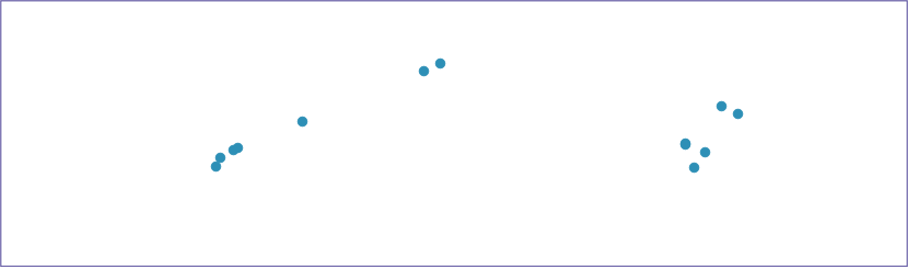
These are water features at a specific location best represented as a point such as issues, sinks and culvert entrance.
{% endtab %}
{% tab title="Water Body Catchments" %}
These are river catchments published by authoritative bodies. Where there is a long river they are broken into sections.
{% endtab %}
{% tab title="River Basin Districts" %}
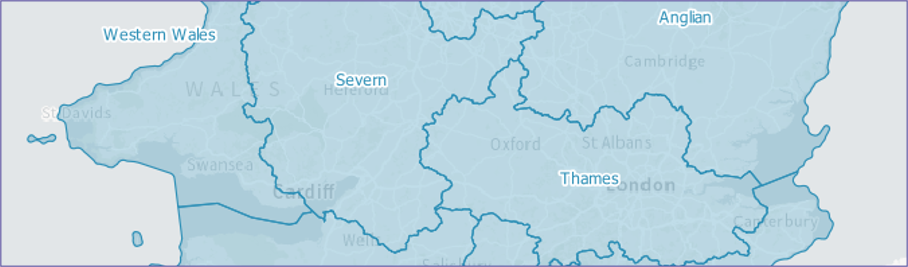
These are the macro river basins published by authoritative bodies named by region (South West, Anglian) or for the major river that runs through it (Humber, Severn).
{% endtab %}
{% endtabs %}
## Tidal Boundary
Although the geometry for the Tidal Boundary feature type is not new, the way it has been brought together is.
OS MasterMap Topography Layer represented MHW(S) and MLW(S) as two feature types. However, if the waterline was also a building, that would take precedence.
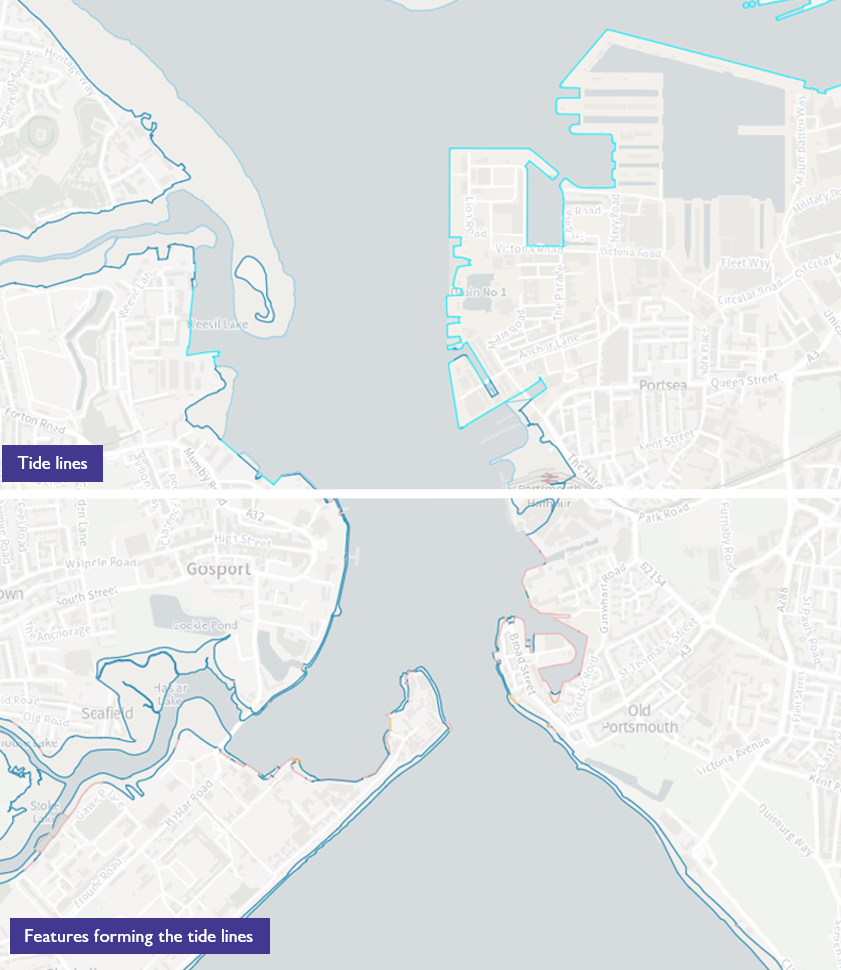
In this data all of the tide lines are in one layer and they are attributed as to what tide line they show (upper image)
* Mean High Water (Springs)
* Mean Low Water (Springs)
* Mean High and Low Water (Springs)
The data is also attributed to show what the feature forming the tide line is (lower image):
* Building Wall
* Built Obstruction
* Fixed Structure
* Lock Gate
* No Physical Feature (as you would expect on a beach)
Tidal Boundary Features styled by High or Low (top) and by feature type (bottom)
## Continuous Tidal Boundary
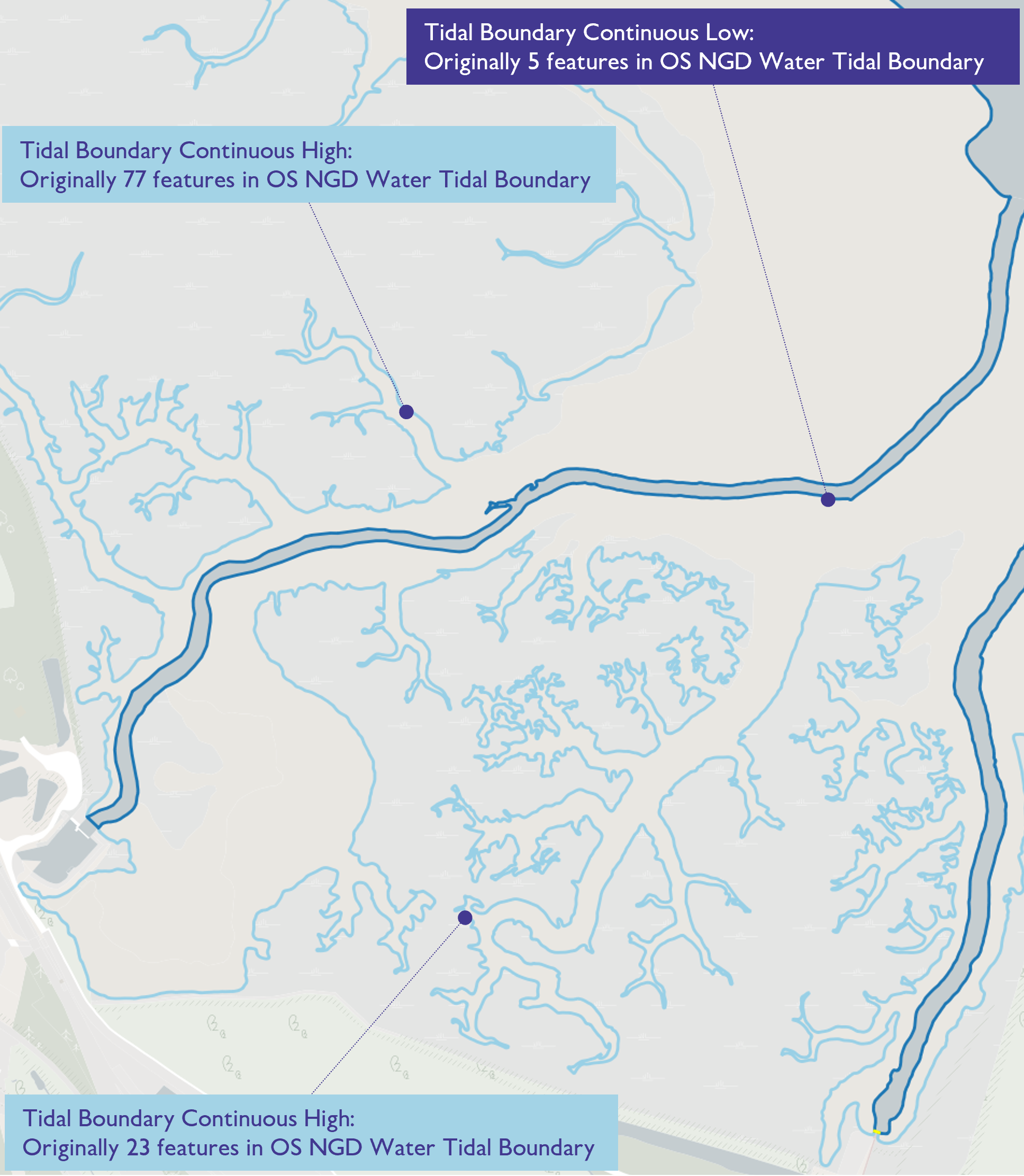
The Continuous Tidal Boundary data is an amalgamation of the OS NGD Tidal Boundary features designed to reduce the number of tidal feature lines present in the data.
There are two new Water Features
* Tidal Boundary Continuous High: a dataset of Mean High Water and Mean High Water Springs
* Tidal Boundary Continuous Low: a dataset of Mean Low Water and Mean Low Water Springs
In OS NGD Water Tidal Boundary the MHW(S) and MLW(S) features are broken into a number of separate lines.
The Continuous Tidal Boundary Low and High are created by joining together the MHW(S) and MLW(S) features into longer linear features which only break at a point where MHW(S) and MLW(S) meet.
Where MHW(S) and MLW(S) are contiguous, the feature appears in both Feature Types.
Continuous Tidal Boundary features showing how many features they are formed from
## Intertidal features
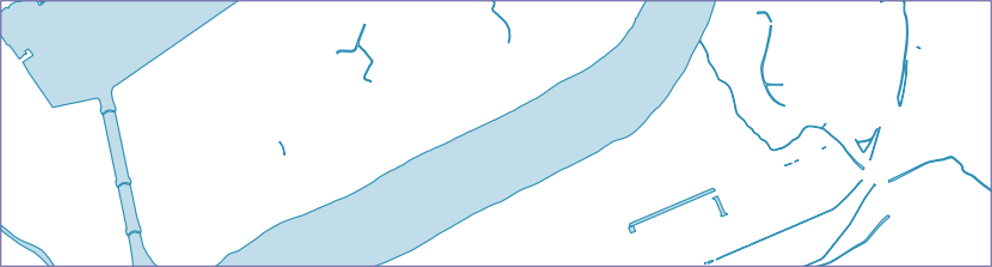
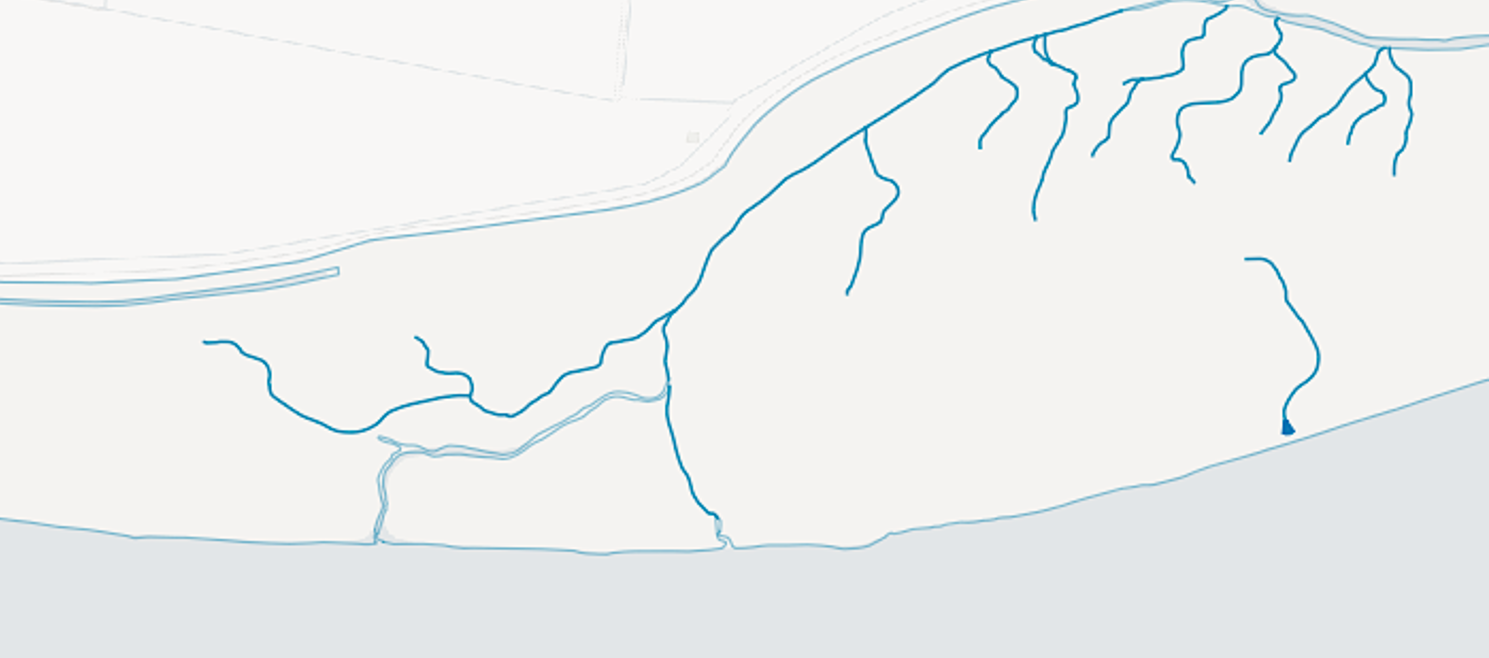
Intertidal lines are a new feature in OS NGD Data and represent features that exist between Mean High and Mean Low Water (Springs).
These features have been present in the OS database that sits behind products and are being exposed to users for the first time as part of the OS NGD data
The only two classifications are:
* Watercourse: where a stream runs across the foreshore
* Spreads: where a watercourse dissipates on the shoreline
Intertidal features
## Tidal Water
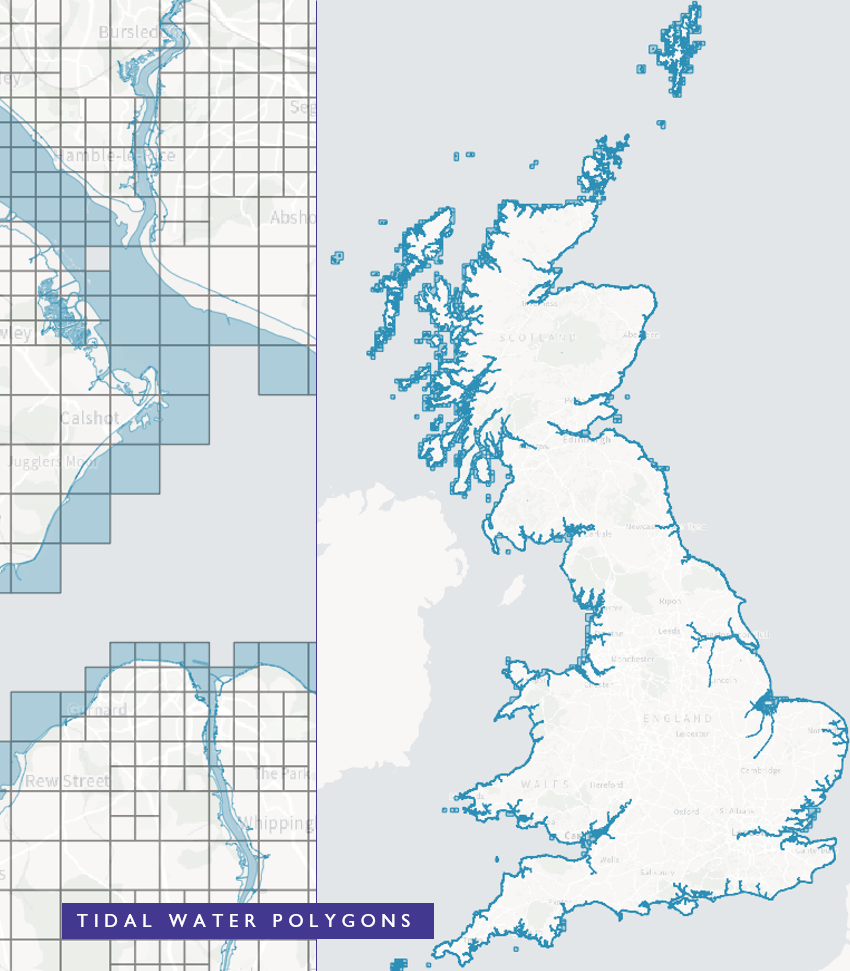
Another new feature of the OS NGD Water Features is the inclusion of Tidal Water polygons.
With OS MasterMap Topography Layer, ‘sea’ polygons stopped at the last point at which a feature broke the water polygon before it entered open sea with no bounding features. This would mean that tidal water often stopped at bridges with a blank on the seaward side.
Although the new Tidal Water polygons extend further out into the sea they do not extend to a fixed distance off shore all the way around the coast. Instead they extend out to the limit of the grid that Ordnance Survey has used to define the extent of Great Britain that it captures.
This means that missing squares in the middle of an area of sea polygons is because that square has no ‘land-based’ detail in it (coastline, islands, and so on) so Ordnance Survey has never produced data for it.
## Water Body Catchments and River Basin Districts
Water Body catchment polygons are new to Ordnance Survey data and represent whole or part of a stream, river, lake, reservoir, estuary or stretch of coastal water
River Basin Districts are a river basin or several river basins together with associated coastal waters. This is the least-detailed level of catchment published by authoritative bodies.
Some of these districts relate to the widest catchments of specific rivers (Solway/Tweed, Dee, Severn, Thames, Humber) others are more regions or partial countries (South West, South East, North West, Anglian, Northumbria, Western Wales, Scotland).
The data has come from the relevant authoritative bodies:
* Environment Agency (England)
* Natural Resources Wales (Wales)
* Scottish Environment Protection Agency (Scotland)
## What formats does the OS NGD Water data come in?
The OS NGD Water data comes in two formats, CSV and GeoPackage (GPKG)
* The GeoPackage format comes ready to load into the GIS package of the users choice with different gpkg files for each layer.
* The CSV format is more suited for loading into a database. It has all of the same layers in csv format and all the same attribution as the GeoPackage, however instead of storing the geometry in a GIS ready format, it is stored as a POLYGON, POINT, LINESTRING or MULTILINESTRING attribute with all of the vertices stored as co-ordinate pairs in the text file
## What is the new attribution?
OS surveyors and remote sensing teams have been capturing and maintaining information on land cover, land use and a more detailed level of description for over 10 years.
This data has been transformed and filtered to match attribution and content for existing products, such as OS MasterMap Topography Layer. However, in the OS NGD data it is being published at the original, more granular level.
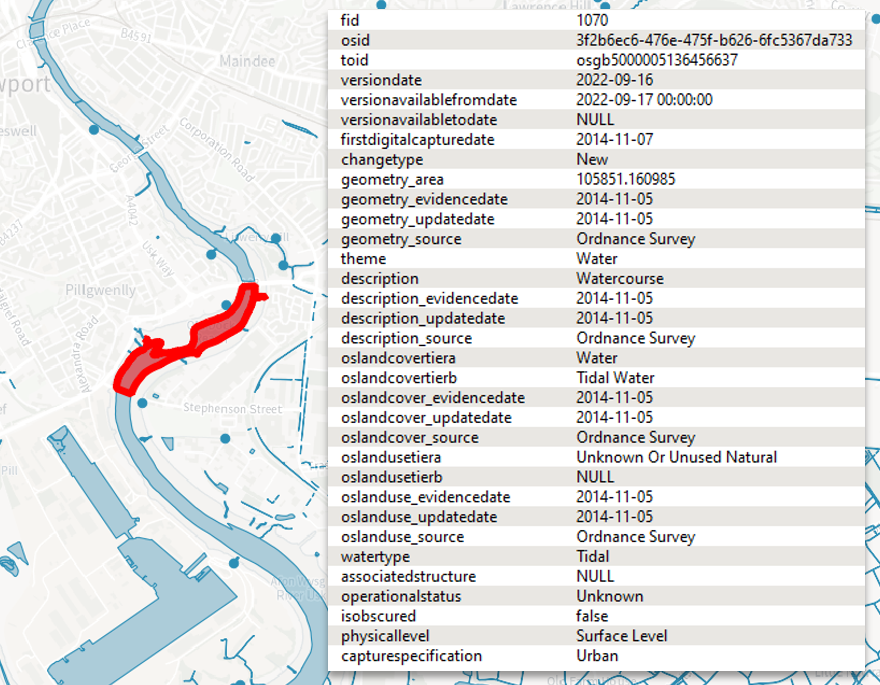
The attribution has changed from the OSMM Topography Layer:
* OS NGD data has an OSID
* The features have a TOID, version date and changetype similar to the OS MasterMap family of products, although the TOID is an optional field
* Land Use and Land Cover information has been added as well as a more detailed Description attribute. The Land Use contains a large amount of ‘Unknown’, but this is due to the nature of the features being water
Water polygon attribution
***
Links that may be useful:
{% embed url="" %}
{% embed url="" %}
{% embed url="" %}
This content has been developed from what was originally a Lightning Talk PowerPoint slide set. These slides are available to PSGA members to view and download from the [PSGA members area of the OS website](https://auth.ordnancesurvey.co.uk/my.policy)
---
# Agent Instructions
This documentation is published with GitBook. GitBook is the documentation platform designed so that both humans and AI agents can read, navigate, and reason over technical content effectively. Learn more at gitbook.com.
## Querying This Documentation
If you need additional information that is not directly available in this page, you can query the documentation by asking a question.
Perform an HTTP GET request on the following URL with the `ask` and `goal` query parameters:
```
GET https://docs.os.uk/more-than-maps/data-demonstrators/topography-demonstrators/os-ngd-water-features.md?ask=&goal=
```
`ask` is the immediate question: it should be specific, self-contained, and written in natural language.
`goal` is what the user is ultimately trying to achieve, the reason they need the answer. Sharing it helps GitBook give you a better, more relevant answer. A goal is most helpful when it describes the outcome the user wants rather than restating the question. For example, with `ask=how do I create an API token`, a goal like `automate deployments from our CI pipeline` lets GitBook tailor the answer to that use case.
The response will contain a direct answer to the question and relevant excerpts and sources from the documentation.
Use this mechanism when the answer is not explicitly present in the current page, you need clarification or additional context, or you want to retrieve related documentation sections.