> For the complete documentation index, see [llms.txt](https://docs.os.uk/os-downloads/llms.txt). Markdown versions of documentation pages are available by appending `.md` to page URLs; this page is available as [Markdown](https://docs.os.uk/os-downloads/products/addresses-and-names-portfolio/os-open-names/os-open-names-getting-started-guide.md).
# OS Open Names Getting Started Guide
This getting started guide provides instructions for using OS Open Names in different software applications. Users with limited technical knowledge will be able to follow this guide.
OS Open Names is a geographic directory that contains basic information about identifiable places in Great Britain. The content is divided into themes based on type and local type classification values. The data contains accurate and current settlement names, road names and numbers, postcodes and their locations, additional contextual information and links to other datasets. The primary use of the product is to provide the location of named places to support a wealth of activities, such as discovery, identification, visualisation, geocoding, routing and navigation, and linking of diverse information.
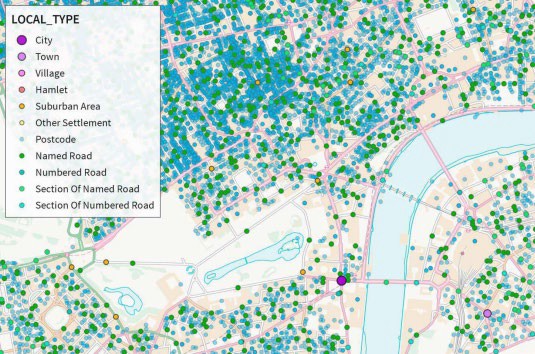
OS Open Names example map showing geographical locations for identifiable places.
This [getting started guide](/os-downloads/products/addresses-and-names-portfolio/os-open-names/os-open-names-getting-started-guide.md) focuses on using the product in comma-separated values (CSV) format.
For general guidance on using the product in GeoPackage format, please see the [Getting started with GeoPackage guide](/os-downloads/resources/product-resources/getting-started-with-geopackage-and-vector-tiles-guides/getting-started-with-geopackage.md).
---
# Agent Instructions
This documentation is published with GitBook. GitBook is the documentation platform designed so that both humans and AI agents can read, navigate, and reason over technical content effectively. Learn more at gitbook.com.
## Querying This Documentation
If you need additional information that is not directly available in this page, you can query the documentation by asking a question.
Perform an HTTP GET request on the following URL with the `ask` and `goal` query parameters:
```
GET https://docs.os.uk/os-downloads/products/addresses-and-names-portfolio/os-open-names/os-open-names-getting-started-guide.md?ask=&goal=
```
`ask` is the immediate question: it should be specific, self-contained, and written in natural language.
`goal` is what the user is ultimately trying to achieve, the reason they need the answer. Sharing it helps GitBook give you a better, more relevant answer. A goal is most helpful when it describes the outcome the user wants rather than restating the question. For example, with `ask=how do I create an API token`, a goal like `automate deployments from our CI pipeline` lets GitBook tailor the answer to that use case.
The response will contain a direct answer to the question and relevant excerpts and sources from the documentation.
Use this mechanism when the answer is not explicitly present in the current page, you need clarification or additional context, or you want to retrieve related documentation sections.