> For the complete documentation index, see [llms.txt](https://docs.os.uk/os-downloads/llms.txt). Markdown versions of documentation pages are available by appending `.md` to page URLs; this page is available as [Markdown](https://docs.os.uk/os-downloads/products/addresses-and-names-portfolio/os-open-names/os-open-names-overview.md).
# OS Open Names Overview
This overview introduces OS Open Names and gives context for all users – highlighting key features, providing examples of potential uses, and listing details such as file sizes, supply formats, etc.
OS Open Names is a geographic directory that contains basic information about identifiable places (i.e. named places). The content of the product is divided into themes based on type and local type classification values. The data contains accurate and current settlement names, road names and numbers, postcodes and their locations, with additional contextual information and links to other datasets. It is designed for use across all market sectors and can be used for web service and mobile development.
In addition to the data product, OS Open Names content is available through the OS Names API (application programming interface), which is accessible via the [OS Data Hub](https://osdatahub.os.uk/).
The primary use of the product is to provide the location for a named place to support a wealth of activities such as discovery, identification, visualisation, geocoding, routing and navigation, and linking diverse information.
The name of the place is the key property used for querying. It is also recognised that a place may have multiple names as its official name may be defined in multiple languages (English / Welsh or English / Gaelic), for example, Cardiff (English) and Caerdydd (Welsh). Where relevant, we give a second name, with the language being specified.
Names are not unique, so additional location information is provided to enable users to refine their query to select the named place they are interested in. Additional location information includes postcode district, populated place, district / borough, county / unitary authority, European region, and country.
The OS Open Names specification will extend the Infrastructure for Spatial Information in the European Community (INSPIRE) Geographical Names theme to ensure that it is compliant with European open data initiatives.
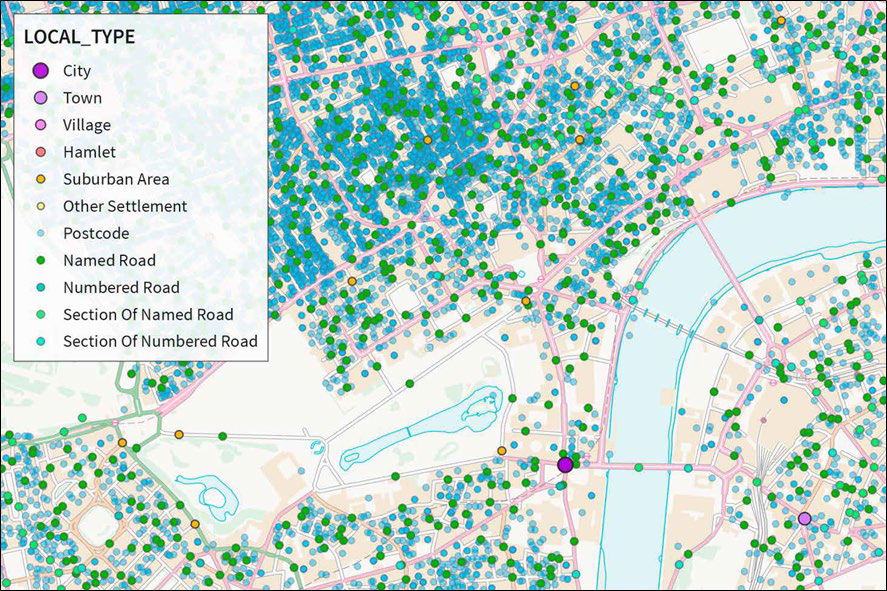
The range of features included in OS Open Names.
OS Open Names has a resolution of 1 metre. The definition of how the locations are generated is outlined in the [Technical Specification](/os-downloads/products/addresses-and-names-portfolio/os-open-names/os-open-names-technical-specification.md).
The persistent unique identifier enables features to be quickly and easily identified and can be used for better data management. The exceptions to this are Section of Named Road and Section of Numbered Road, which don’t have a persistent identifier. More information on this can be found in the [Technical Specification](/os-downloads/products/addresses-and-names-portfolio/os-open-names/os-open-names-technical-specification.md).
The links to other gazetteers, such as DBpedia and GeoNames, encourage wider use of the product and enable users to embed it more easily into their systems and processes if they already use one of these gazetteers.
The contextual geography attributes, such as DISTRICT\_BOROUGH, enable features with the same name to be identified quickly through enhanced querying for greater accuracy of results.
Bounding boxes, or Minimum Bounding Rectangles (MBR), are given for roads and settlements. These can be used to quickly zoom to the extent of a feature in a GIS (geographic information system) map widow, application or web service.
## How to use the data
For guidance on using the data, please refer to the [Getting Started Guide](/os-downloads/products/addresses-and-names-portfolio/os-open-names/os-open-names-getting-started-guide.md).
---
# Agent Instructions
This documentation is published with GitBook. GitBook is the documentation platform designed so that both humans and AI agents can read, navigate, and reason over technical content effectively. Learn more at gitbook.com.
## Querying This Documentation
If you need additional information that is not directly available in this page, you can query the documentation by asking a question.
Perform an HTTP GET request on the following URL with the `ask` and `goal` query parameters:
```
GET https://docs.os.uk/os-downloads/products/addresses-and-names-portfolio/os-open-names/os-open-names-overview.md?ask=&goal=
```
`ask` is the immediate question: it should be specific, self-contained, and written in natural language.
`goal` is what the user is ultimately trying to achieve, the reason they need the answer. Sharing it helps GitBook give you a better, more relevant answer. A goal is most helpful when it describes the outcome the user wants rather than restating the question. For example, with `ask=how do I create an API token`, a goal like `automate deployments from our CI pipeline` lets GitBook tailor the answer to that use case.
The response will contain a direct answer to the question and relevant excerpts and sources from the documentation.
Use this mechanism when the answer is not explicitly present in the current page, you need clarification or additional context, or you want to retrieve related documentation sections.