# OS Open UPRN Documentation

An open dataset enabling linking, sharing and visualisation of data related to Unique Property Reference Numbers (UPRNs).

{% hint style="info" %}
**This product is updated every six weeks, in-line with the AddressBase Epoch dates published on the** [**'Product Refresh Dates' page**](https://docs.os.uk/os-downloads/resources/product-resources/product-refresh-dates#addressbase-products)**.**
{% endhint %}

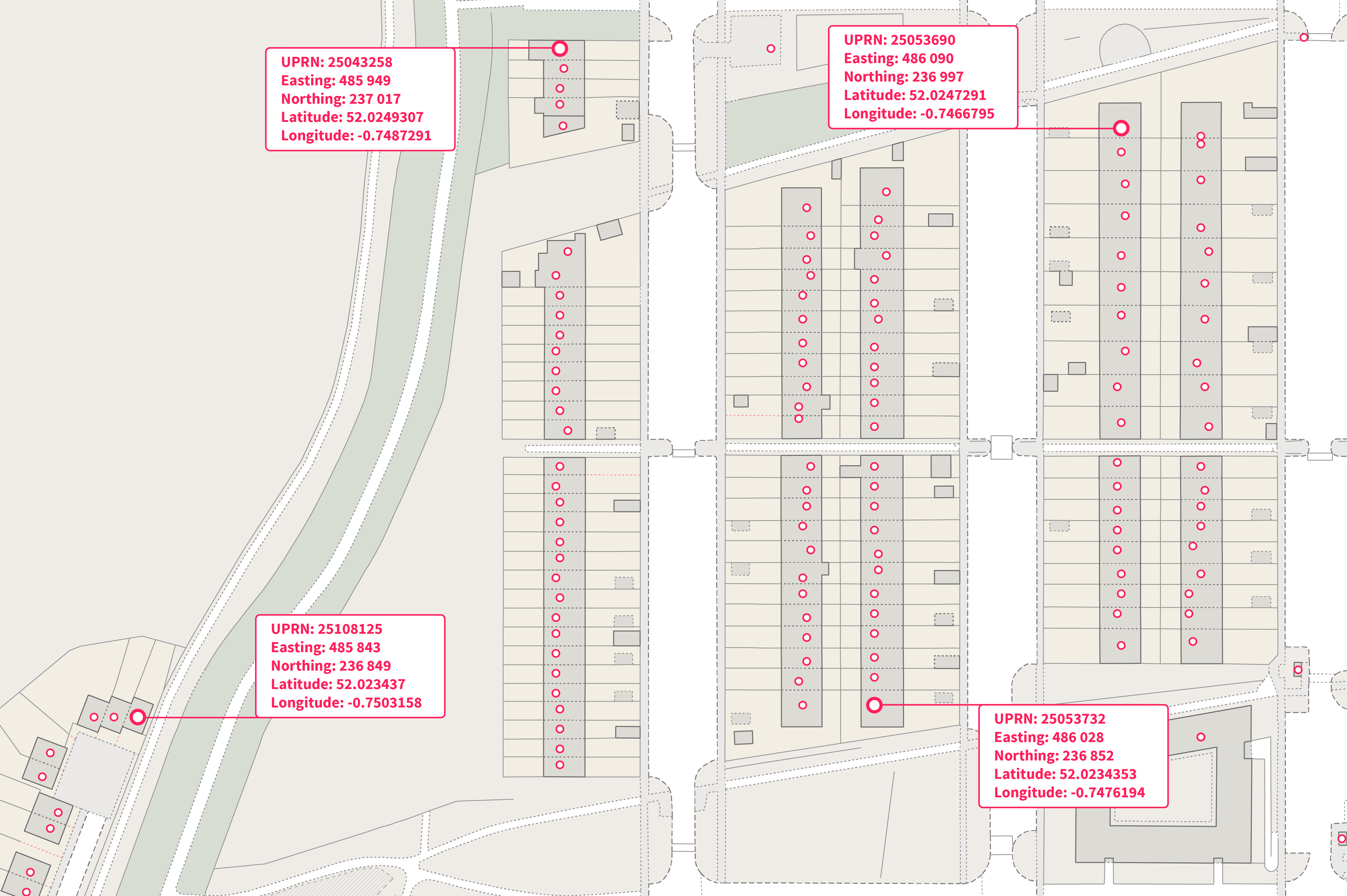
<figure><img src="https://1897589978-files.gitbook.io/~/files/v0/b/gitbook-x-prod.appspot.com/o/spaces%2FcNpJpLP8RROUaWVQo5ea%2Fuploads%2FUE7Vn7zIxQljRvmIi0Ne%2Fopen_uprn_residential.png?alt=media&#x26;token=58a7d2b7-c0b0-402d-8548-b3e2bf0a0e41" alt="Representation of UPRN data showing an identifier linked to each property on a background map" width="563"><figcaption><p>Representation of OS Open UPRN data against a background map.</p></figcaption></figure>

UPRNs are the authoritative identifier used to uniquely identify addressable locations in Great Britain; they are essential for bringing property and address information together.

{% hint style="info" %}
OS Open UPRN is part of the OS Open Identifiers 'Family' of products, which includes four OpenData products: OS Open Linked Identifiers, OS Open TOID, OS Open UPRN and OS Open USRN. The products within this family allow you to easily share information held against a range of identifiers and to link together information associated with these identifiers.
{% endhint %}

{% tabs %}
{% tab title="Benefits" %}
**Unique Property Reference Number**

A Unique Property Reference Number (UPRN) is a unique numeric identifier for every addressable location in Great Britain, found in OS's [AddressBase](https://docs.os.uk/os-downloads/products/addresses-and-names-portfolio/addressbase-fundamentals) products.

**Addressable features**

UPRNs are assigned to approximately 40 million addressable locations, which may be any kind of building, residential or commercial. The addressable location may also be an object that might not have a ‘postal ’ address – such as a bus shelter or an electricity sub-station.

**Share and link data**

OS Open UPRN will enable you to share and link data related to UPRNs, which you can spatially analyse and visualise using the accurate location.

**Authoritative source**

The UPRNs in OS Open UPRN are primarily allocated by local authorities, under their legal duty to maintain this information. This means you can have confidence you're accessing an authoritative source of these identifiers.

**Identifiers you can trust**

The UPRN is a persistent identifier to an addressable location that is never re-used, allowing you to confidently manage associated information to an address.
{% endtab %}

{% tab title="Use Cases" %}
OS Open UPRN enables users to:

* Share information held against a UPRN with a location
* Link together information associated with UPRNs
  {% endtab %}

{% tab title="Summary" %}

* **Access:** Download via the [OS Data Hub](https://osdatahub.os.uk/)
* **Data theme:** Address
* **Data structure:** Vector – Identifiers
* **Coverage:** Great Britain
* **Scale:** 1:1 250 to 1:10 000
* **Format:** CSV, GeoPackage
* **Ordering area:** All of Great Britain
  {% endtab %}
  {% endtabs %}

## How to get this product

Access to this OS OpenData product is free through the [OS Data Hub](https://osdatahub.os.uk/data/downloads/open/OpenUPRN).

## Other ways to access this data

OS Open UPRN data is available through our [OS Features API](https://docs.os.uk/os-apis/accessing-os-apis/os-features-api), building on the OS Open UPRN product with detailed data from a range of OS products and services, providing a rich array of attribute filters and combinations. [Visit the OS API docs site](https://docs.os.uk/os-apis) to unlock programmatic access to rich geospatial data and integrate OS data and services into your applications.

## What's next?

To access additional documentation and resources relating to this product, please refer to the following:

<table data-view="cards"><thead><tr><th></th><th></th><th></th><th data-hidden data-card-cover data-type="image">Cover image</th><th data-hidden data-card-target data-type="content-ref"></th></tr></thead><tbody><tr><td><h4>Overview</h4></td><td>The overview introduces OS Open UPRN and gives context for all users – highlighting key features, providing examples of potential uses, and listing details such as supply formats, currency, etc.</td><td></td><td data-object-fit="cover" data-alt="Example image showing OS Open UPRN product data over a background map."><a href="https://1897589978-files.gitbook.io/~/files/v0/b/gitbook-x-prod.appspot.com/o/spaces%2FcNpJpLP8RROUaWVQo5ea%2Fuploads%2FyjujVPXGarXyuGRpSwgR%2Fopen_uprn_datahub_2_large.png?alt=media&#x26;token=417b0048-9d76-4ca4-915f-bddcbb067c85">open_uprn_datahub_2_large.png</a></td><td><a href="os-open-uprn/os-open-uprn-overview">os-open-uprn-overview</a></td></tr><tr><td><h4>Technical Specification</h4></td><td>The technical specification provides detailed technical information about OS Open UPRN. It is targeted at technical users and software developers.</td><td></td><td data-object-fit="cover" data-alt="Example image showing OS Open UPRN product data over a background map."><a href="https://1897589978-files.gitbook.io/~/files/v0/b/gitbook-x-prod.appspot.com/o/spaces%2FcNpJpLP8RROUaWVQo5ea%2Fuploads%2FUE7Vn7zIxQljRvmIi0Ne%2Fopen_uprn_residential.png?alt=media&#x26;token=58a7d2b7-c0b0-402d-8548-b3e2bf0a0e41">open_uprn_residential.png</a></td><td><a href="os-open-uprn/os-open-uprn-technical-specification">os-open-uprn-technical-specification</a></td></tr><tr><td><h4>Ordnance Survey Website</h4></td><td>View OS Open UPRN product information and find out how to get this product on the OS website.</td><td></td><td></td><td><a href="https://www.ordnancesurvey.co.uk/products/os-open-uprn">https://www.ordnancesurvey.co.uk/products/os-open-uprn</a></td></tr></tbody></table>

{% hint style="info" %}
New users should start with the Overview to gain high-level insight into the product. The Technical Specification contains detailed technical insights.
{% endhint %}