> For the complete documentation index, see [llms.txt](https://docs.os.uk/os-downloads/llms.txt). Markdown versions of documentation pages are available by appending `.md` to page URLs; this page is available as [Markdown](https://docs.os.uk/os-downloads/products/buildings-and-infrastructure-portfolio/os-open-linked-identifiers/os-open-linked-identifiers-technical-specification/road_toid_street_usrn_10.md).
# Road\_TOID\_Street\_USRN\_10
This document aims to provide all the information to evaluate if the method of associating the respective identifiers is suitable for your needs. These identifier relationships have been extracted from existing premium products and are presented in a standalone table for easy and open access to the information. It describes which product the information was extracted from, what information was extracted and how the source product derived the original association between the identifiers.
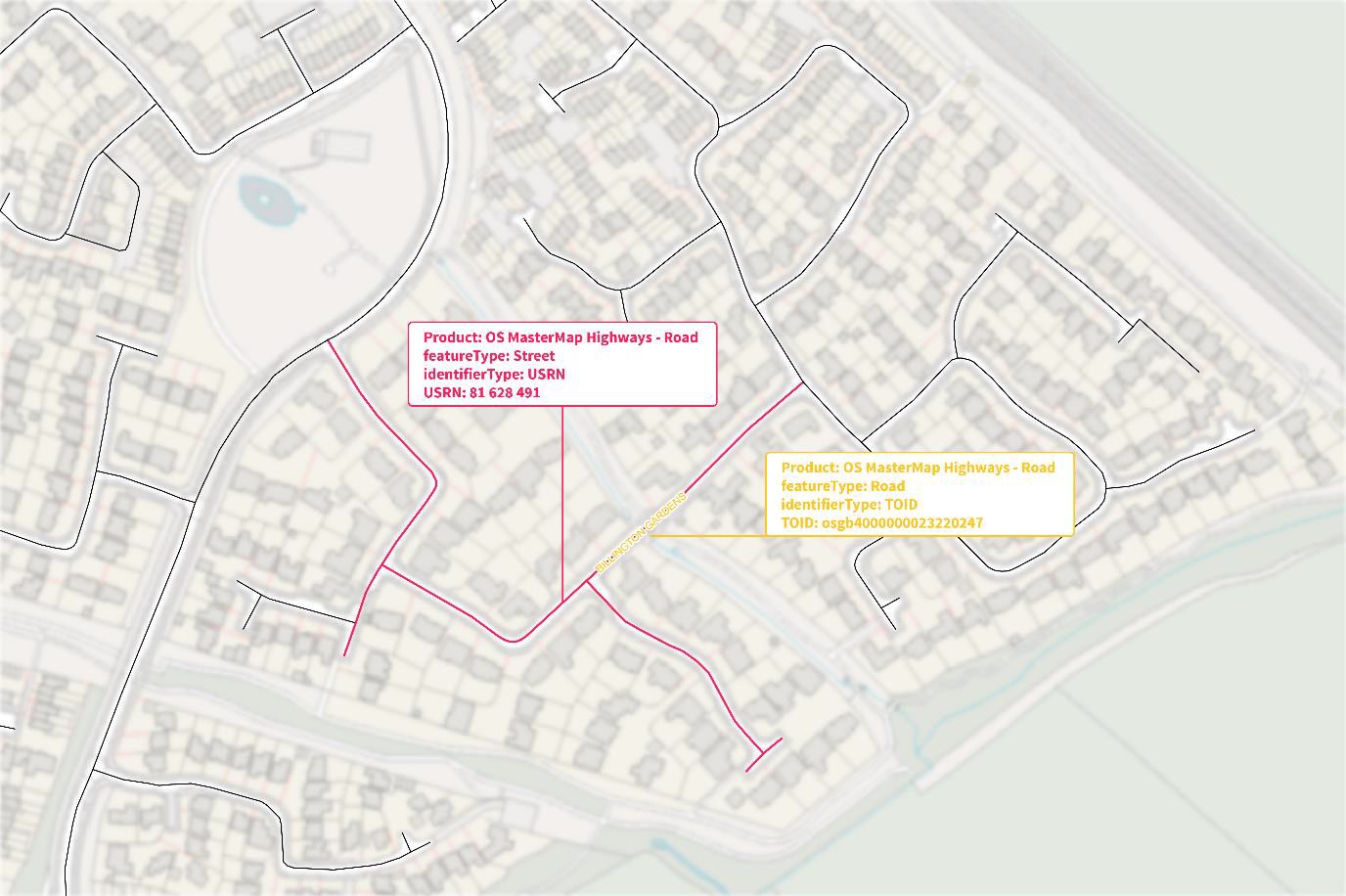
Identifiers displayed on OS Map data showing RoadLink and Topographic area feature types
## Relationship Extraction
This relationship is between the Topographic Identifier (TOID) of the Road features and the Unique Street Reference Number (USRN) of Street features in *OS MasterMap Highways Network*.
A Road feature is a link set which represents a collection of RoadLink features that share the same name (e.g. Bilston Road) or classification number (e.g. A41). A USRN is an 8-digit unique and persistent identifier for a street assigned by a Roads Authority or Highway Authority. Where possible, the geometry of Streets provided by the Roads or Highway Authorities is spatially matched to the geometry of OS RoadLink(s) and an aggregated geometry of the RoadLink(s) will be provided in the *OS MasterMap Highways Network*.
The relationship is extracted using the following:
* The reference to the RoadLinks which make up each Road feature in the ‘link’ attribute of the Road
feature table.
* The reference to the RoadLink(s) which have been matched to each Street feature in the ‘link’ attribute in the Street feature table within the *OS MasterMap Highways Network – Roads* product following its release.
Where the Road and Street features reference common RoadLink(s), the relationship is extracted.
## Correlation Method
The relationship is determined by two link references within *OS MasterMap Highways Network - Roads*, demonstrating where Road and Street features reference common RoadLink(s).
As this relationship is determined using a single source product the version information provided will always be the same as the version of the feature used to create the correlation. A Confidence Value is assigned to indicate the reliability of the version information provided in this product in relation to the version of the features used to form the correlation in the original product. The Confidence Value is given for each relationship, which will always be defined in this relationship as:
| Confidence Value | Definition |
| ------------------------------ | ---------------------------------------------------------------------------------------------------------- |
| Version information is correct | The version information provided is the same as the version of the feature used to create the correlation. |
---
# Agent Instructions
This documentation is published with GitBook. GitBook is the documentation platform designed so that both humans and AI agents can read, navigate, and reason over technical content effectively. Learn more at gitbook.com.
## Querying This Documentation
If you need additional information that is not directly available in this page, you can query the documentation by asking a question.
Perform an HTTP GET request on the following URL with the `ask` and `goal` query parameters:
```
GET https://docs.os.uk/os-downloads/products/buildings-and-infrastructure-portfolio/os-open-linked-identifiers/os-open-linked-identifiers-technical-specification/road_toid_street_usrn_10.md?ask=&goal=
```
`ask` is the immediate question: it should be specific, self-contained, and written in natural language.
`goal` is what the user is ultimately trying to achieve, the reason they need the answer. Sharing it helps GitBook give you a better, more relevant answer. A goal is most helpful when it describes the outcome the user wants rather than restating the question. For example, with `ask=how do I create an API token`, a goal like `automate deployments from our CI pipeline` lets GitBook tailor the answer to that use case.
The response will contain a direct answer to the question and relevant excerpts and sources from the documentation.
Use this mechanism when the answer is not explicitly present in the current page, you need clarification or additional context, or you want to retrieve related documentation sections.