> For the complete documentation index, see [llms.txt](https://docs.os.uk/os-downloads/llms.txt). Markdown versions of documentation pages are available by appending `.md` to page URLs; this page is available as [Markdown](https://docs.os.uk/os-downloads/products/land-and-terrain-portfolio/os-terrain-5/os-terrain-5-technical-specification/esri-shapefile.md).

# Esri shapefile

The Esri shapefiles consist of eight separate files for the point and line features.

Esri shapefiles are a simple, non-topological format for storing the geometric location and attribute information of geographic features. A shapefile is one of the spatial data formats that you can work with in ArcGIS.

The shapefile format defines the geometry and attributes of geographically referenced features in as many as five files with specific file extensions that should be stored in the same project workspace. The file extensions and their uses are as follows:

* .shp: The file that stores the feature geometry.
* .shx: The file that stores the index of the feature geometry.
* .dbf: The dBASE file that stores the attribute information of features. When a shapefile is added as a theme to a view, this file is displayed as a feature table.
* .sbn and .sbx: The files that store the spatial index of the features. These two files will only exist if you perform theme-on-theme selection, spatial joins or create an index on a theme’s SHAPE field.
* .prj: The file that stores the projection information.

## Data structure <a href="#id-3.2.2-data-structure" id="id-3.2.2-data-structure"></a>

| Layer name                                                                                                               | Layer description                                                                    |
| ------------------------------------------------------------------------------------------------------------------------ | ------------------------------------------------------------------------------------ |
| <p>\<tile name>\_line.shp</p><p>\<tile name>\_line.dbf</p><p>\<tile name>\_line.shx</p><p>\<tile name>\_line.prj</p>     | Esri shapefiles for contour and tideline data.                                       |
| <p>\<tile name>\_point.shp</p><p>\<tile name>\_point.dbf</p><p>\<tile name>\_point.shx</p><p>\<tile name>\_point.prj</p> | Esri shapefiles for spot height data.                                                |
| Metadata\_\<tile name>.xml                                                                                               | A metadata file for contour data providing information on the flying date and so on. |

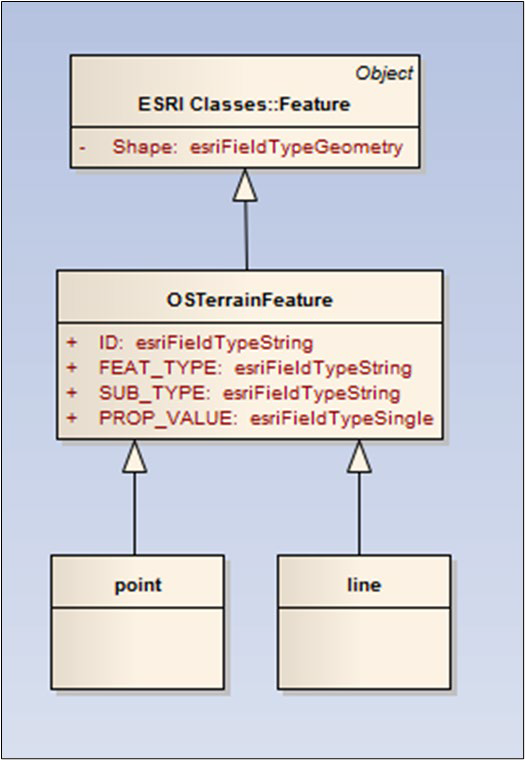
### Detailed shapefile model <a href="#id-3.2.3-detailed-shapefile-model" id="id-3.2.3-detailed-shapefile-model"></a>

<figure><img src="/files/GYtmA9OLFWx1rFFogdSS" alt="" width="394"><figcaption><p>UML diagram of the Shapefile contour data model</p></figcaption></figure>


---

# Agent Instructions
This documentation is published with GitBook. GitBook is the documentation platform designed so that both humans and AI agents can read, navigate, and reason over technical content effectively. Learn more at gitbook.com.

## Querying This Documentation
If you need additional information that is not directly available in this page, you can query the documentation dynamically by asking a question.

Perform an HTTP GET request on the current page URL with the `ask` query parameter, and the optional `goal` query parameter:

```
GET https://docs.os.uk/os-downloads/products/land-and-terrain-portfolio/os-terrain-5/os-terrain-5-technical-specification/esri-shapefile.md?ask=<question>&goal=<endgoal>
```

`ask` is the immediate question: it should be specific, self-contained, and written in natural language.
`goal` is optional and describes the broader end goal you are ultimately trying to accomplish on behalf of the user. GitBook uses it to tailor the answer towards what is most useful for that goal.

The response will contain a direct answer to the question and relevant excerpts and sources from the documentation.

Use this mechanism when the answer is not explicitly present in the current page, you need clarification or additional context, or you want to retrieve related documentation sections.
