# Seamless data supply

A principle of OS MasterMap Topography Layer is that data is seamless, which means there are no fixed units of data supply. The nominal boundary of each packet of OS MasterMap Topography Layer data is defined by the user’s data selection polygon and by the data chunking method applied to break the supply into manageable units (if used).

With respect to the nominal boundary, data is supplied unclipped. This means that all features with geometry that overlaps the nominal boundary are supplied in their entirety.

## Inconsistent features <a href="#id-3.8-inconsistent-features" id="id-3.8-inconsistent-features"></a>

There are occasions when a data update will temporarily leave a feature in an inconsistent state. This occurs when neighbouring data is updated, and the edits are applied to the seamless database at different times. According to the type of feature, the following results may be realised:

## Polygon boundary duplication <a href="#id-3.8.1-polygon-boundary-duplication" id="id-3.8.1-polygon-boundary-duplication"></a>

A break in a polygon boundary on the edge of an update area will cause neighbouring features to take on identical geometric properties and the broken line work to be removed from all polygon structuring. Once the update is completed, the polygons will resume their respective boundaries.

### **Example**

<figure><img src="/files/XBNnylZnwaGV3IY9V9zx" alt="An example of polygon boundary duplication before, during and after a data update." width="503"><figcaption><p>An example of polygon boundary duplication before, during and after a data update.</p></figcaption></figure>

## Disappearing polygon features <a href="#id-3.8.2-disappearing-polygon-features" id="id-3.8.2-disappearing-polygon-features"></a>

Where a polygon boundary is broken and there is no neighbouring polygon, the feature will be temporarily removed from supply. A query on this area between updates will not return the broken feature. A change- only query will return a departed feature (i.e. a Delete) to indicate that this feature has been removed from the supply. Once the complete edit has been applied to the database, the feature will be supplied with its original identity and history.

## Broken lines <a href="#id-3.8.3-broken-lines" id="id-3.8.3-broken-lines"></a>

A polyline that crosses an updated area boundary may occasionally be broken by a partial update. Where this occurs, the line is flagged as broken and the component parts will be output separately in a multiline geometry.

## Intersecting polygon boundaries <a href="#id-3.9-intersecting-polygon-boundaries" id="id-3.9-intersecting-polygon-boundaries"></a>

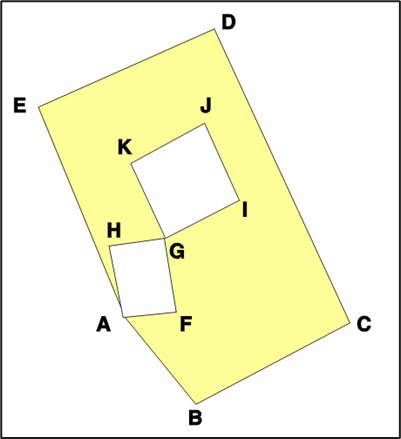
Some polygons have inner boundaries that have a common point with each other or with the outer boundary. In this case, each loop formed where the boundary returns to the common point is treated as a separate boundary.

### **Example**

<figure><img src="/files/hPsAFjYbmrY41dbsahwV" alt="An example of intersecting polygon boundaries. There is one large polygon that has two smaller polygons within it." width="301"><figcaption><p>An example of intersecting polygon boundaries. There is one large polygon that has two smaller polygons within it.</p></figcaption></figure>

This polygon has an outer boundary (ABCDEA) and two inner boundaries (AHGFA and GKJIG).


---

# Agent Instructions: Querying This Documentation

If you need additional information that is not directly available in this page, you can query the documentation dynamically by asking a question.

Perform an HTTP GET request on the current page URL with the `ask` query parameter:

```
GET https://docs.os.uk/os-downloads/products/maps-and-imagery-portfolio/os-mastermap-topography-layer/os-mastermap-topography-layer-technical-specification/seamless-data-supply.md?ask=<question>
```

The question should be specific, self-contained, and written in natural language.
The response will contain a direct answer to the question and relevant excerpts and sources from the documentation.

Use this mechanism when the answer is not explicitly present in the current page, you need clarification or additional context, or you want to retrieve related documentation sections.