> For the complete documentation index, see [llms.txt](https://docs.os.uk/os-downloads/llms.txt). Markdown versions of documentation pages are available by appending `.md` to page URLs; this page is available as [Markdown](https://docs.os.uk/os-downloads/products/transport-network-portfolio/os-mastermap-highways-network-paths/os-mastermap-highways-network-paths-technical-specification/feature-types/ferrylink.md).
# FerryLink
A FerryLink is a linear spatial object which represents the connectivity of a vehicular ferry route across a body of water. A FerryLink will only be captured where the route is limited to pedestrians only and both terminals are within Great Britain, and there is a timetabled service which is open to the public.
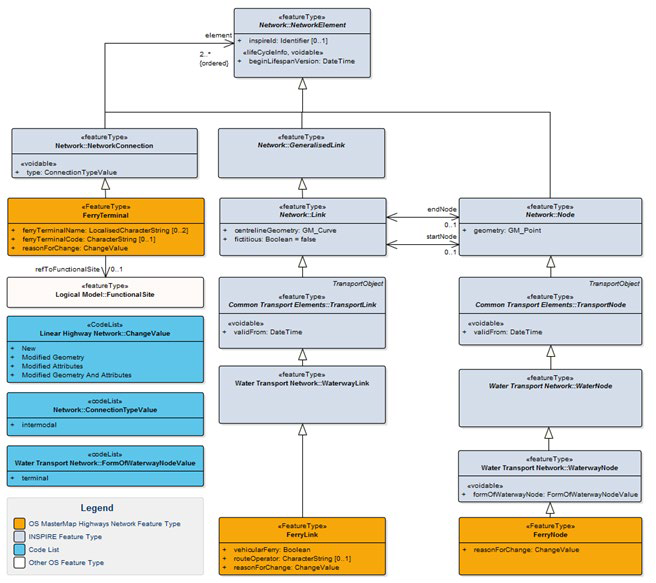
The context diagram shows how the FerryLink has been inherited from INSPIRE, the attribution held on the FerryLink and how it relates to the other Ferry components.
Context Diagram: FerryLink, FerryNode and FerryTerminal
## FerryLink Attributes
A network link representing a route for a vehicular or pedestrian ferry route.
### id
Unique identifier; for FerryLink, this is a TOID.
* **Attribute name**: gml\_id (GML), toid (GeoPackage), toid (Vector Tiles)
* **Type**: CharacterString
* **Size**: 20
* **Multiplicity**: \[1]
### identifier
Uniform Resource Identifier.
* **Attribute name**: identifier (GML), identifier (GeoPackage), Not provided (Vector Tiles)
* **Type**: CharacterString
* **Size**: 37
* **Multiplicity**: \[1]
### inspireId
External object identifier of the spatial object.
* **Attribute name**: inspireId
* **Type**: Identifier
* **Multiplicity**: \[0..1]
### beginLifespanVersion
Date and time at which this version of the spatial object was inserted or changed in the spatial data set.
{% hint style="info" %}
The time part is always set to zero.
{% endhint %}
* **Attribute name**: beginLifespanVersion (GML), begin\_lifespan\_version (GeoPackage), Not provided (Vector Tiles)
* **Type**: DateTime
* **Multiplicity**: \[1]
### centrelineGeometry
The three-dimensional geometry that represents the connection between the ferry terminals. Where a detailed alignment is provided it is only an indication of the route a vessel would take. The third dimension is only provided for connectivity and does not reflect any real-world value.
* **Attribute name**: Not provided (GML), geometry (GeoPackage), Not provided (Vector Tiles)
* **Type**: GM\_Curve
* **Multiplicity**: \[1]
### fictitious
Indicator that the centreline geometry of the link is a straight line with no intermediate control points – unless the straight line represents the geography in the resolution of the data set appropriately.
* **Attribute name**: fictitious (GML), fictitious (GeoPackage), Not provided (Vector Tiles)
* **Type**: Boolean
* **Size**: 5
* **Multiplicity**: \[1]
### validFrom
The time when the transport node started to exist in the real world.
{% hint style="info" %}
The time part is always set to zero.
{% endhint %}
* **Attribute name**: validFrom (GML), valid\_from (GeoPackage), Not provided (Vector Tiles)
* **Type**: DateTime
* **Multiplicity**: \[1]
### vehicularFerry
An indicator if this FerryLink represents a ferry that can be used by vehicles.
{% hint style="info" %}
This will always be set to false in the Path Network product.
{% endhint %}
* **Attribute name**: vehicularFerry (GML), vehicular\_ferry (GeoPackage), vehicular\_ferry (Vector Tiles)
* **Type**: Boolean
* **Size**: 5
* **Multiplicity**: \[1]
### routeOperator
The URL to the operator of this Ferry route.
* **Attribute name**: routeOperator (GML), route\_operator (GeoPackage), route\_operator (Vector Tiles)
* **Type**: CharacterString
* **Size**: 250
* **Multiplicity**: \[0..1]
### reasonForChange
The reason for a change made to a feature.
* **Attribute name**:reasonForChange (GML), reason\_for\_change (GeoPackage), Not provided (Vector Tiles)
* **Type**: [ChangeValue](/os-downloads/products/transport-network-portfolio/os-mastermap-highways-network-fundamentals/os-mastermap-highways-network-code-lists/changevalue.md)
* **Size**: 32
* **Multiplicity**: \[1]
### startNode
The node coincident with the first vertex of the geometry attribute.
* **Attribute name**: startNode (GML), start\_node (GeoPackage), Not provided (Vector Tiles)
* **Size**: 20
* **Multiplicity**: \[0..1]
### endNode
The node coincident with the last vertex of the geometry attribute.
* **Attribute name**: endNode (GML), end\_node (GeoPackage), Not provided (Vector Tiles)
* **Size**: 20
* **Multiplicity**: \[0..1]
---
# Agent Instructions
This documentation is published with GitBook. GitBook is the documentation platform designed so that both humans and AI agents can read, navigate, and reason over technical content effectively. Learn more at gitbook.com.
## Querying This Documentation
If you need additional information that is not directly available in this page, you can query the documentation dynamically by asking a question.
Perform an HTTP GET request on the following URL with the `ask` and `goal` query parameters:
```
GET https://docs.os.uk/os-downloads/products/transport-network-portfolio/os-mastermap-highways-network-paths/os-mastermap-highways-network-paths-technical-specification/feature-types/ferrylink.md?ask=&goal=
```
`ask` is the immediate question: it should be specific, self-contained, and written in natural language.
`goal` is what the user is ultimately trying to achieve, the reason they need the answer. Sharing it helps GitBook give you a better, more relevant answer. A goal is most helpful when it describes the outcome the user wants rather than restating the question. For example, with `ask=how do I create an API token`, a goal like `build a script that syncs our docs to a CMS` lets GitBook tailor the answer to that use case.
The response will contain a direct answer to the question and relevant excerpts and sources from the documentation.
Use this mechanism when the answer is not explicitly present in the current page, you need clarification or additional context, or you want to retrieve related documentation sections.