# Product structure

OS MasterMap Water Network Layer is a topological network representing the watercourses within Great Britain.&#x20;

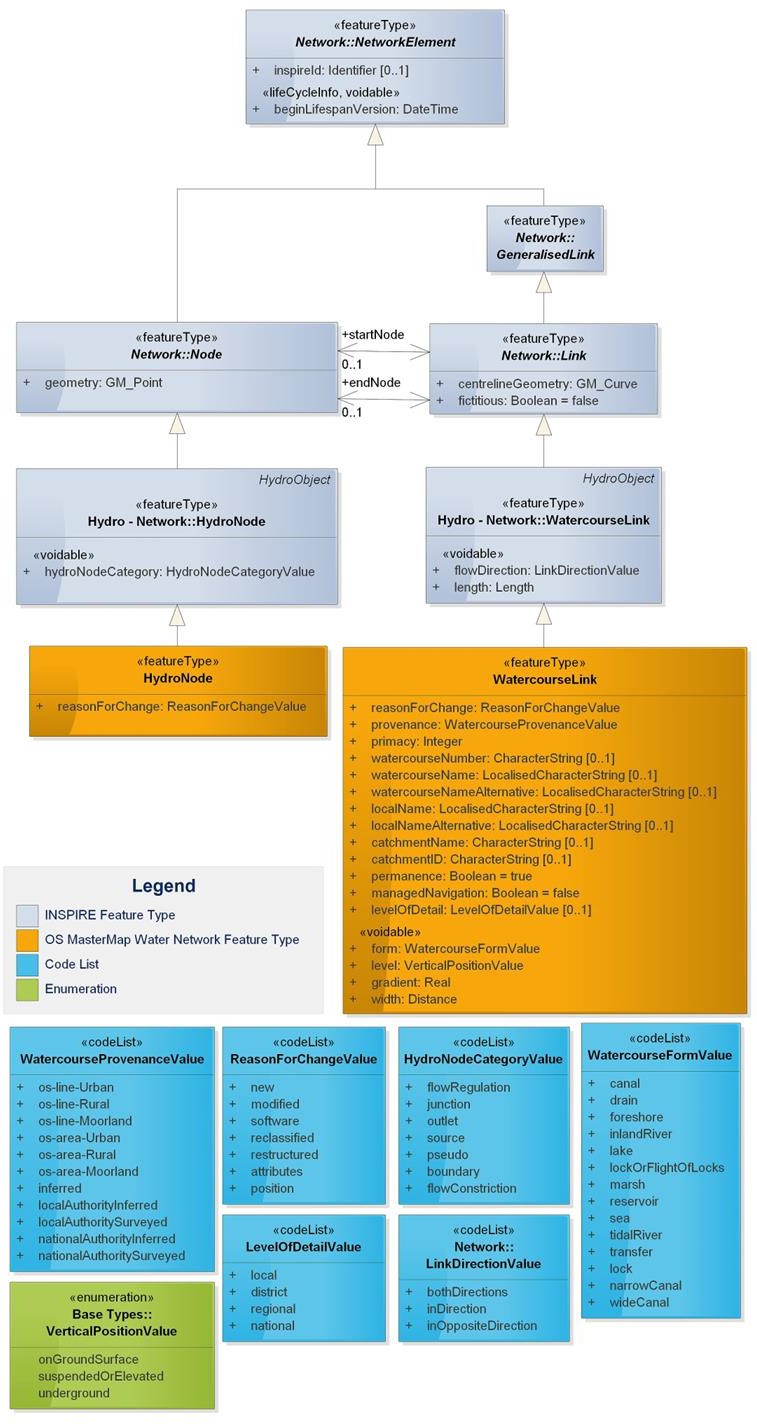
The product is made up of five feature types:

* **WatercourseLink:** Features that represent the approximate central alignment of a watercourse, including rivers, lakes and canals. They can represent part of a watercourse or a whole watercourse.
* **HydroNode:** Features that represent a river’s source, end, a junction where three or more links meet, and places where the real-world related attribution changes, for example, the point where a watercourse becomes tidal.
* **WatercourseSeparatedCrossing:** Features to indicate the relationships between watercourses that intersect at different levels.
* **WatercourseLinkSet:** Features to represent sets of links, for example, named rivers or watercourses within a catchment area.
* **WatercourseInteraction:** Features that represent events along the water network, for example, weirs and mooring points.

Only two feature types are supplied in the product: WatercourseLink and HydroNode. This technical specification will cover all five of the feature types which make up the product as all five feature types are referenced in the product schema, which is the controlling specification for the product.

All the feature instances, of whichever feature type, are provided as a single FeatureCollection.

OS MasterMap Water Network Layer has been built with the INSPIRE Hydro – Network Specification as a basis, which results in the product inheriting attribution from INSPIRE. An overview of the product structure can be found in the image below, which highlights the inherited INSPIRE feature types and attribution.

Properties of the INSPIRE specification which are voidable and are not being populated in the product have not been included in the class diagrams below or in the following feature type pages. For information on the INSPIRE properties which are not included in this product, please see the [INSPIRE Data Specification on Hydrography – Network application schema](https://knowledge-base.inspire.ec.europa.eu/index_en).

<figure><img src="/files/Z6HFzq3NVubOwuOaDUlt" alt="UML Diagram showing the data structure of OS MasterMap Water Network Layer in the current release. Grey indicates an INSPIRE Feature Type; orange indicates the two OS MasterMap Water Network Layer feature types; blue indicates the six code lists and green indicates the enumeration. The feature types, code lists and enumeration are detailed in full in the following sub-sections of this Technical Specification." width="563"><figcaption><p><em>UML diagram showing the data structure of OS MasterMap Water Network Layer in the current release.</em></p></figcaption></figure>
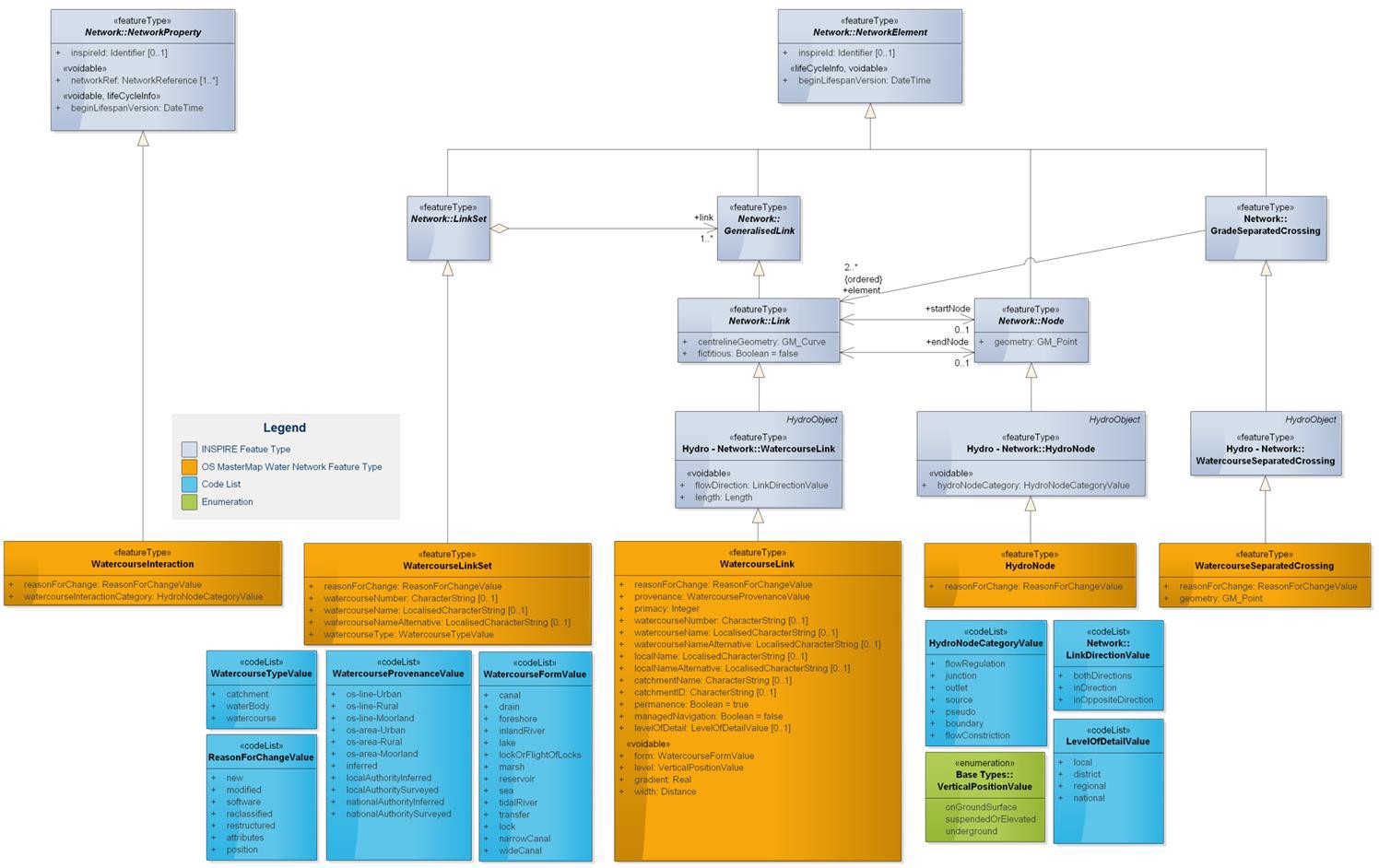
<figure><img src="/files/yWB2buI3W9pFdONhxwzh" alt="UML diagram of OS MasterMap Water Network Layer product structure referenced by the schema. Grey indicates an INSPIRE Feature Type; orange indicates the five OS MasterMap Water Network Layer feature types; blue indicates the seven code lists and green indicates the enumeration. The feature types, code lists and enumeration are detailed in full in the following sub-sections of this Technical Specification."><figcaption><p><em>UML diagram of OS MasterMap Water Network Layer product structure referenced by the schema.</em></p></figcaption></figure>


---

# Agent Instructions: Querying This Documentation

If you need additional information that is not directly available in this page, you can query the documentation dynamically by asking a question.

Perform an HTTP GET request on the current page URL with the `ask` query parameter:

```
GET https://docs.os.uk/os-downloads/resources/product-resources/end-of-life-product-documentation/os-mastermap-water-network-layer/os-mastermap-water-network-layer-technical-specification/product-structure.md?ask=<question>
```

The question should be specific, self-contained, and written in natural language.
The response will contain a direct answer to the question and relevant excerpts and sources from the documentation.

Use this mechanism when the answer is not explicitly present in the current page, you need clarification or additional context, or you want to retrieve related documentation sections.
