> For the complete documentation index, see [llms.txt](https://docs.os.uk/osngd/llms.txt). Markdown versions of documentation pages are available by appending `.md` to page URLs; this page is available as [Markdown](https://docs.os.uk/osngd/getting-started/downloading-with-os-select+build/getting-started-with-os-recommended-recipes/identifying-higher-risk-buildings-recipe-guide.md).

# Identifying higher-risk buildings recipe guide

## What is the identifying higher-risk buildings recipe? <a href="#what-is-the-greenspace-recipe" id="what-is-the-greenspace-recipe"></a>

The guide below provides a geospatial toolkit that will help you use OS NGD data to identify if a building in occupation in Great Britain is classified as higher-risk by the Building Safety Act 2022 and the Higher-Risk Buildings (Descriptions and Supplementary Provisions) Regulations 2023.

### Higher-risk buildings criteria

The criteria used to identify higher-risk buildings within this recipe guide have been drawn from official Government guidance – please see ['criteria for determining whether a building is a higher-risk building during the occupation phase of the new higher-risk regime' from the Gov.uk website](https://www.gov.uk/guidance/criteria-for-being-a-higher-risk-building-during-the-occupation-phase-of-the-new-higher-risk-regime) for full details.

The **key criteria** are:

* Minimum of 2 residential units
* Minimum of 7 storeys or minimum height of 18m

The following **exemptions** apply:&#x20;

* Where a building meets the above criteria but is comprised entirely of one or more of the following categories, it's exempt from classification as a higher-risk building:
  * Care homes
  * Hospitals
  * Secure residential institutions
  * Hotels (serviced apartments and short-term lets do not fall within the meaning of hotel)
  * Military barracks

### Feature types required

The following two feature types are included in the identifying higher-risk buildings recipe:

| Theme            | Collection           | Feature Type                                                               |
| ---------------- | -------------------- | -------------------------------------------------------------------------- |
| OS NGD Address   | OS GB Address        | [Built Address](/osngd/data-structure/address/gb-address/built-address.md) |
| OS NGD Buildings | OS Building Features | [Building](/osngd/data-structure/buildings/building-features/building.md)  |

You can adapt the suggested identifying higher-risk buildings recipe at the recipe creation or editing stage so that it fully meets your needs.

Applying filters (see steps 8 and 9 below) in OS Select+Build to both feature types at the recipe creation (or recipe editing) stage lets you target the right types of residential and commercial addresses, buildings over a certain height, and buildings with over a certain number of floors. Filtering will also reduce the number of features being downloaded.

You can skip the filtering steps (8 and 9) at the recipe creation stage, download all features for the two feature types, then subsequently filter the data later in your chosen geographic information system (GIS) or relational database management system (RDBMS).

## Creating the recipe

To create the identifying higher-risk buildings recipe in OS Select+Build:

{% stepper %}
{% step %}

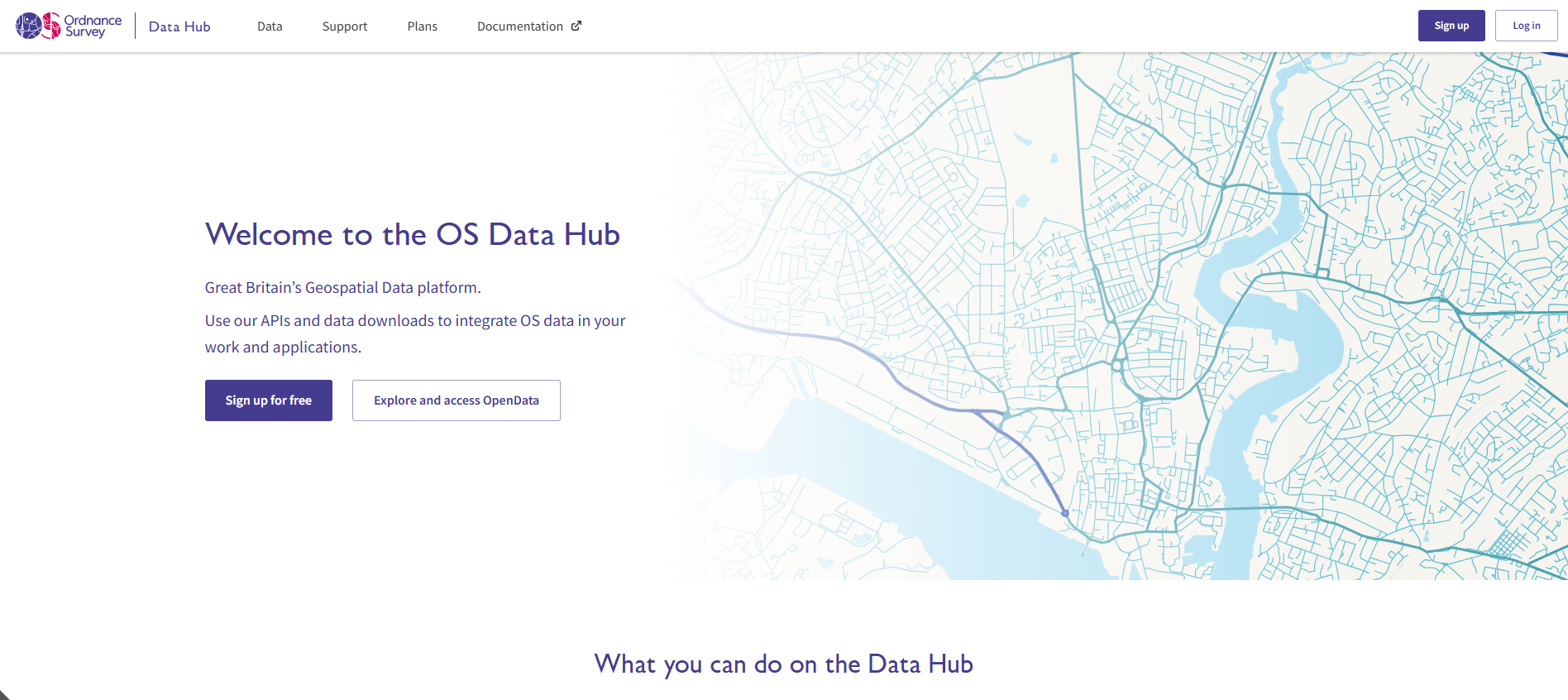
### Log into your [OS Data Hub](https://osdatahub.os.uk/) account

Click *Log in* on the OS Data Hub menu bar to log into your account.

<figure><img src="/files/3Sc8dpyyNulwMK7oHF60" alt="A screenshot of the OS Data Hub home page showing the sign up and log in buttons in the top right hand corner" width="563"><figcaption><p>Screenshot showing the OS Data Hub homepage.</p></figcaption></figure>
{% endstep %}

{% step %}

### Navigate to the OS Data Hub workspace

Select *Data* from the menu bar to view your workspace.
{% endstep %}

{% step %}

### Navigate to the OS Select+Build Recipe Library

Choose *Downloads* > *OS Select+Build Recipe Library* from the left-hand-side secondary navigation menu.

<figure><img src="/files/82g7GmJIrcJdN4rgCo6M" alt="Screenshot of the OS Select+Build Recipe Library screen in the OS Data Hub."><figcaption><p>Screenshot of the OS Select+Build Recipe Library screen in the OS Data Hub.</p></figcaption></figure>
{% endstep %}

{% step %}

### Choose Create a new recipe

Click the *Create a new recipe* button at the top right-hand-side of the screen.
{% endstep %}

{% step %}

### Give the recipe a name and description

* Give your recipe a descriptive name in the *Recipe name* dialog box on the left-hand-side of the screen.
* Add a detailed description for your recipe (this is optional, but it's useful if other team members will be accessing the recipe).
  {% endstep %}

{% step %}

### Select the feature types

Select your OS NGD data by choosing the themes, collections and feature types you want to include in your recipe. You'll need to select the following two feature types from the *Themes* panel on the left-hand-side of the screen:&#x20;

* Built Address (found within *Address* > *GB Address* > *Built Address*)
* Building (found within *Buildings* > *Building Features* > *Building*)

{% hint style="info" %}
**Note:** Only these two individual feature types are needed for this recipe – do not select all feature types from the OS GB Address and OS Building Features Collections.
{% endhint %}

<figure><img src="/files/3RHvO3GE9kV0oMx4MyEA" alt="Screenshot showing the tree view in the secondary navigation menu that opens when you create a recipe in OS Select+Build in the OS Data Hub. Both of the feature types needed for the identifying higher-risk buildings recipe are shown to have been selected in this screenshot: Built Address and Building."><figcaption><p>Screenshot showing the tree view in the secondary navigation menu that opens when you create a recipe in OS Select+Build in the OS Data Hub. Both of the feature types needed for the identifying higher-risk buildings recipe are shown to have been selected in this screenshot: Built Address and Building.</p></figcaption></figure>
{% endstep %}

{% step %}

### (Optional) Choose a data schema version

Selecting a data schema version for a feature type is an optional step; if you don't choose a particular data schema version for a feature type, OS Select+Build will always select the latest available data schema version for you for each feature type by default. We recommend using the pre-selected latest data schema version for feature types unless you have a specific need to use an earlier one. (See the [Data schema versioning page](/osngd/getting-started/os-ngd-fundamentals/data-schema-versioning.md) for more information on data schema versioning in the OS NGD.)

If you wish to choose which schema version (where applicable) you'd like to receive the data in for a feature type, click on the feature type name within the tree view in the secondary navigation menu, then choose a data schema version from the *Choose Data Schema* drop-down box in the right-hand side panel.

<figure><img src="/files/q8cwGOcqupM4GYwfClvY" alt="Screenshot showing the tree view in the secondary navigation menu that opens when you create a recipe in OS Select+Build in the OS Data Hub. The Building Feature Type has been selected in this screenshot and the Choose Schema Version drop-down menu is visible in the right-hand-side panel, which lets you select the data schema version you want to use for the feature type."><figcaption><p>Screenshot showing the tree view in the secondary navigation menu that opens when you create a recipe in OS Select+Build in the OS Data Hub. The Building Feature Type has been selected in this screenshot and the <em>Choose Schema Version</em> drop-down menu is visible in the right-hand-side panel, which lets you select the data schema version you want to use for the feature type.</p></figcaption></figure>
{% endstep %}

{% step %}

### Add a filter to the Built Address Feature Type

{% hint style="info" %}

#### Why are filters needed in this recipe?

OS Select+Build provides the option to apply filters on certain attributes when creating a recipe so that only the features and attribution that are needed are included in the data. Filters need to be set one at a time for each feature type in this recipe.

For this recipe, attribute filters will be used on both feature types to target the right types of residential and commercial addresses, buildings over a certain height, and buildings with over a certain number of floors. Filtering will also reduce the number of features being downloaded.

However, you may wish to download all features for the two feature types instead, then subsequently filter the data later in your chosen geographic information system (GIS) or relational database management system (RDBMS) – if so, just skip steps 8 and 9.
{% endhint %}

To add a filter to the Built Address Feature Type:

* Click on the *filter icon* <img src="/files/DAnRQnNlQi1GZ1GjiYXW" alt="Filter icon in OS Select+Build" data-size="line"> to the right of Built Address in the theme selection tree.

<figure><img src="/files/BjBWNjst2Kxj3K4dTxdC" alt="Screenshot of the theme selection tree in OS Select+Build. The Address, GB Address and Built Address boxes have been selected. A filter option is visible to the right of the Built Address name." width="368"><figcaption><p>Screenshot of the theme selection tree in OS Select+Build.</p></figcaption></figure>

*The Advanced Filter Options panel will then slide into view from the right-hand side of the screen and you can begin to build your filter. For this filter, you'll need to add two groups, then assign rules to both groups.​*

In the Advanced Filter Options panel:

* Click the *+ Add Group* button twice.
* Select whether you would like the relationship between the two groups to have an And or an Or condition. In this case, you should select *Or* from the And / Or selector.

<figure><img src="/files/rpZqrChZHn8v3yQjt5pp" alt="Screenshot of creating a filter in the Advanced Filter Options panel in OS Select+Build. Two groups have been added to the filter with an Or condition between them."><figcaption><p>Screenshot of creating a filter in the Advanced Filter Options panel in OS Select+Build. Two groups have been added to the filter with an Or condition between them.</p></figcaption></figure>

In the first group:

* Click *the + Add rule* button twice, which will give you three rules in the first group.
* In the first rule, select *primaryClassificationDescription* from the first drop-down. Leave the operator in the second drop-down as: = (i.e. the equal sign), then select *Residential* from the third drop-down.
* In the second rule, select *secondaryClassificationDescription* from the first drop-down, set the operator in the second drop-down as *In*, then select *Dwelling*, *House In Multiple Occupation*, and *Residential Institution* from the third drop-down.
* In the third rule, select *buildStatus* from the first drop-down. Leave the operator in the second drop-down as: = (i.e. the equal sign), then select *Built Complete* from the third drop-down.
* Before continuing to the second group, select whether you would like the three rules within the first group to have an And or an Or condition. In this case, you should select *And* from the And / Or selector.

<figure><img src="/files/ARPTTYJ0O4O5MZjLWjA1" alt="Screenshot of creating a filter in the Advanced Filter Options panel in OS Select+Build. The first group of the filter options needed for the Built Address Feature Type is shown in this screenshot."><figcaption><p>Screenshot of creating a filter in the Advanced Filter Options panel in OS Select+Build. The first group of the filter options needed for the Built Address Feature Type is shown in this screenshot.</p></figcaption></figure>

In the second group:

* Click *the + Add rule* button three times, which will give you four rules in the second group.
* In the first rule, select *primaryClassificationDescription* from the first drop-down. Leave the operator in the second drop-down as: = (i.e. the equal sign), then select *Commercial* from the third drop-down.
* In the second rule, select *secondaryClassificationDescription* from the first drop-down, set the operator in the second drop-down as = (i.e. the equal sign), then select *Hotel / Motel / Boarding / Guest House* from the third drop-down.
* In the third rule, select *tertiaryClassificationDescription* from the first drop-down, set the operator in the second drop-down as = (i.e. the equal sign), then select *Holiday Let / Accommodation / Short-Term Let Other Than CH01* from the third drop-down.
* In the fourth rule, select *buildStatus* from the first drop-down. Leave the operator in the second drop-down as: = (i.e. the equal sign), then select *Built Complete* from the third drop-down.
* Before continuing, select whether you would like the four rules within the second group to have an And or an Or condition. In this case, you should select *And* from the And / Or selector.

<figure><img src="/files/HAkKH1eaWuGHxPNdnNEV" alt="Screenshot of creating a filter in the Advanced Filter Options panel in OS Select+Build showing all of the group and rule filter options selected for the Built Address Feature Type."><figcaption><p>Screenshot of creating a filter in the Advanced Filter Options panel in OS Select+Build showing all of the group and rule filter options selected for the Built Address Feature Type.</p></figcaption></figure>

* Click the *Apply filter* button.
* Close the Advanced Filter Options panel.
  {% endstep %}

{% step %}

### Add a filter to the Building Feature Type

To add a filter to the Building Feature Type:

* Click on the *filter icon* <img src="/files/DAnRQnNlQi1GZ1GjiYXW" alt="Filter icon in OS Select+Build" data-size="line"> to the right of Building in the theme selection tree.

<figure><img src="/files/w3Ws4gKnnH8OdRakK9RZ" alt="Screenshot of the theme selection tree in OS Select+Build. The Address, GB Address, Built Address, Buildings, Building Features, and Building boxes have been selected. A filter option is visible to the right of the Built Address and Building names." width="349"><figcaption><p>Screenshot of the theme selection tree in OS Select+Build.</p></figcaption></figure>

*The Advanced Filter Options panel will then slide into view from the right-hand side of the screen and you can begin to build your filter. This time you'll add a rule first, followed by a&#x20;group, then you'll add two rules to the group.​*

In the Advanced Filter Options panel:

* Click the *+ Add rule* button, then select *physicalState* from the first drop-down. Leave the operator in the second drop-down as: = (i.e. the equal sign), then select *Built* from the third drop-down.

<figure><img src="/files/u7TQv8JsYwzn2C0afGrU" alt="Screenshot of creating a filter in the Advanced Filter Options panel in OS Select+Build. The first rule of the filter options needed for the Building Feature Type is shown in this screenshot."><figcaption><p>Screenshot of creating a filter in the Advanced Filter Options panel in OS Select+Build. The first rule of the filter options needed for the Building Feature Type is shown in this screenshot.</p></figcaption></figure>

* Click the *+ Add Group* butto&#x6E;*.*
* Select whether you would like the relationship between the rule and the group to have an And or an Or condition. In this case, you should select *And* from the And / Or selector.

<figure><img src="/files/KCtGRoTb9rGkAL8iK6lC" alt="Screenshot of creating a filter in the Advanced Filter Options panel in OS Select+Build. The first rule and the group filter options needed for the Building Feature Type are shown in this screenshot."><figcaption><p>Screenshot of creating a filter in the Advanced Filter Options panel in OS Select+Build. The first rule and the group filter options needed for the Building Feature Type are shown in this screenshot.</p></figcaption></figure>

In the group:

* In the first rule, select *numberOfFloors* from the first drop-down, set the operator in the second drop-down as Over Or Equal To (>=), then type *7* into the third box.
* Click the *+ Add rule* button to add a second rule to the group.
* In the second rule, select *height\_relativeMax\_m* from the first drop-down, set the operator in the second drop-down as Over Or Equal To (>=), then type *18* into the third box.
* Before continuing, select whether you would like the two rules within the group to have an And or an Or condition. In this case, you should select *Or* from the And / Or selector.

<figure><img src="/files/8qL5MPN2Z9GKrTerogLC" alt="Screenshot of creating a nested filter in the Advanced Filter Options panel in OS Select+Build. The complete filter options selected for the Building Feature Type are shown in this screenshot."><figcaption><p>Screenshot of creating a nested filter in the Advanced Filter Options panel in OS Select+Build. The complete filter options selected for the Building Feature Type are shown in this screenshot.</p></figcaption></figure>

* Click the *Apply filter* button.
* Close the Advanced Filter Options panel.
  {% endstep %}

{% step %}

### Finish creating the recipe

Once you've applied filters to the two feature types, click the *Create recipe* button to complete the recipe creation process. Your new recipe will now instantly be available in your OS Select+Build Recipe Library.

You can view a summary of the completed safer routes to schools recipe, including the required feature types and filters, if you click *Data* > *Downloads* > *OS Select+Build Recipe Library* > \**your recipe's name*\* > *View all filters*.

The recipe summary should look like the screenshot below:

<figure><img src="/files/8yPyB04Os9srqcrROFev" alt="Screenshot of the OS Select+Build Recipe details screen showing a summary of the identifying higher-risk buildings recipe, including selected feature types and their data schema versions, plus all filters applied."><figcaption><p>Screenshot of the OS Select+Build Recipe details screen showing a summary of the identifying higher-risk buildings recipe, including selected feature types and their data schema versions, plus all filters applied.</p></figcaption></figure>
{% endstep %}
{% endstepper %}

***

## What's next?

### Further guidance on creating, editing and deleting recipes

More information on creating, editing and deleting recipes in OS Select+Build and on adding attribute filters to recipes can be found in the following guides:

<table data-view="cards"><thead><tr><th></th><th data-hidden data-card-target data-type="content-ref"></th></tr></thead><tbody><tr><td><h4><span data-gb-custom-inline data-tag="emoji" data-code="1f4d6">📖</span> Getting started with recipes guides</h4></td><td><a href="/pages/FFLCsUJ8bw4ivKkAAw6A">/pages/FFLCsUJ8bw4ivKkAAw6A</a></td></tr><tr><td><h4><span data-gb-custom-inline data-tag="emoji" data-code="1f3af">🎯</span> Getting started with attribute filtering guide</h4></td><td><a href="/pages/18KWipcZ6JfvfOyQ5BLE">/pages/18KWipcZ6JfvfOyQ5BLE</a></td></tr></tbody></table>

### Add a data package to your recipe

Once you've created your recipe, you'll need to add a data package to receive the data. Data packages allow you to select the format, update frequency and area of interest for the required data.&#x20;

The following guide will help you to create a data package from your new recipe:

<table data-view="cards"><thead><tr><th></th><th data-hidden data-card-target data-type="content-ref"></th></tr></thead><tbody><tr><td><h4><span data-gb-custom-inline data-tag="emoji" data-code="1f4da">📚</span> Getting started with data packages guide</h4></td><td><a href="/pages/tYEcT0HESurW948j2rj7">/pages/tYEcT0HESurW948j2rj7</a></td></tr></tbody></table>

### Creating maps to identify higher-risk buildings from your recipe using QGIS and ArcGIS Pro

Once you've created your recipe and added a data package to it to receive the data, you can import the data into your chosen GIS to analyse it or create maps.

The following guides will help you to create maps to identify higher-risk buildings in ArcGIS Pro and QGIS:

<table data-view="cards"><thead><tr><th></th><th data-hidden data-card-target data-type="content-ref"></th></tr></thead><tbody><tr><td><h4><span data-gb-custom-inline data-tag="emoji" data-code="1f3e2">🏢</span> Guide for using ArcGIS Pro to create maps to identify higher-risk buildings</h4></td><td><a href="https://docs.os.uk/more-than-maps/using-buildings/identifying-higher-risk-buildings-in-arcgis-pro">https://docs.os.uk/more-than-maps/using-buildings/identifying-higher-risk-buildings-in-arcgis-pro</a></td></tr><tr><td><h4><span data-gb-custom-inline data-tag="emoji" data-code="1f5fa">🗺️</span> Guide for using QGIS to create maps to identify higher-risk buildings</h4></td><td><a href="https://docs.os.uk/more-than-maps/using-buildings/identifying-higher-risk-buildings-in-qgis">https://docs.os.uk/more-than-maps/using-buildings/identifying-higher-risk-buildings-in-qgis</a></td></tr></tbody></table>


---

# Agent Instructions
This documentation is published with GitBook. GitBook is the documentation platform designed so that both humans and AI agents can read, navigate, and reason over technical content effectively. Learn more at gitbook.com.

## Querying This Documentation
If you need additional information that is not directly available in this page, you can query the documentation dynamically by asking a question.

Perform an HTTP GET request on the current page URL with the `ask` query parameter, and the optional `goal` query parameter:

```
GET https://docs.os.uk/osngd/getting-started/downloading-with-os-select+build/getting-started-with-os-recommended-recipes/identifying-higher-risk-buildings-recipe-guide.md?ask=<question>&goal=<endgoal>
```

`ask` is the immediate question: it should be specific, self-contained, and written in natural language.
`goal` is optional and describes the broader end goal you are ultimately trying to accomplish on behalf of the user. GitBook uses it to tailor the answer towards what is most useful for that goal.

The response will contain a direct answer to the question and relevant excerpts and sources from the documentation.

Use this mechanism when the answer is not explicitly present in the current page, you need clarification or additional context, or you want to retrieve related documentation sections.
