> For the complete documentation index, see [llms.txt](https://docs.os.uk/osngd/llms.txt). Markdown versions of documentation pages are available by appending `.md` to page URLs; this page is available as [Markdown](https://docs.os.uk/osngd/data-structure/land.md).
# OS NGD Land
## Introduction to the theme
The OS NGD Land Theme contains point, line and polygon features depicting land cover information. These features can be manmade (for example, residential gardens, tennis courts, construction sites) or natural land (for example, heath or rough grassland, marsh, mixed trees). Features which are exclusively associated with buildings, structures, land use, transport, and water are excluded from the OS Land Features Collection and can instead be found in their respective OS NGD features collections: the [OS Building Features](/osngd/data-structure/buildings/building-features.md), [OS Land Use Features](/osngd/data-structure/land-use/land-use-features.md), [OS Structure Features](/osngd/data-structure/structures/structure-features.md), [OS Transport Features](/osngd/data-structure/transport/transport-features.md), and [OS Water Features](/osngd/data-structure/water/water-features.md) Collections.
The OS NGD Land Theme contains some land information data which can also be seen in the [OS MasterMap Topography Layer](https://docs.os.uk/os-downloads/products/maps-and-imagery-portfolio/os-mastermap-topography-layer), [Sites Layer](https://docs.os.uk/os-downloads/products/land-and-terrain-portfolio/os-mastermap-sites-layer), and [Greenspace Layer](https://docs.os.uk/os-downloads/products/land-and-terrain-portfolio/os-mastermap-greenspace-layer) products. The data in the theme is the same as that provided by the three aforementioned OS products, but it has been structured to be more analytical and consistent across the six OS NGD 'features' collections, allowing you to easily select the specific features you require and delivering greater value to users.
For example, in comparison to data in the three aforementioned OS products, the new OS NGD Land Theme data has been enriched with additional attribution, including the following:
* Geometry change metadata
* A Description attribute to provide a one-word or simple phrase description of a feature
* Detailed land use classification
* Detailed land cover classification
* Capture specification to give details about the geography of the area a feature resides in (that is, urban, rural, or moorland)
{% hint style="info" %}
#### How does OS NGD Land Theme data differ from OS NGD Land Use Theme data?
OS NGD Land Theme data contains land cover attribution that describes the **physical and biological surface of the land**. Whereas OS NGD Land Use Theme data contains land use attribution that describes the **human or economic activity taking place on areas of land** (i.e. how areas of land are being used / their purpose).
{% endhint %}
## Data structure
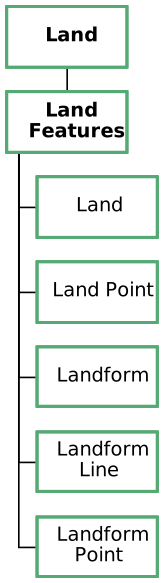
The OS NGD Land Theme is made up of the OS Land Features Collection, which in turn is comprised of five feature types: Land, Land Point, Landform, Landform Line, and Landform Point.
OS NGD Land Theme data structure diagram showing the theme name, collection name and feature type names.
## Unique identifiers
Two unique identifiers are provided with each feature within the OS NGD Land Theme:
* **OSID (Ordnance Survey Identifier)**: The primary identifier and unique key for this theme.
* **TOID (Topographic Identifier)**: An additional secondary identifier which can aid further data linking. TOIDs are an optional attribute and therefore will not always be provided with every feature.
## Useful links
* [An introductory guide to OS NGD Land Theme](https://docs.os.uk/more-than-maps/data-demonstrators/topography-demonstrators/os-ngd-land) data is available on our [More than Maps](https://docs.os.uk/more-than-maps) site; this guide details the layers, formats and attribution available for data in the OS Land Features Collection.
* [An introductory guide to OS NGD Land Cover enhancements](https://docs.os.uk/more-than-maps/data-demonstrators/topography-demonstrators/os-ngd-land-cover-enhancements) is available on our [More than Maps](https://docs.os.uk/more-than-maps) site; this guide details the data enhancements made to five feature types across multiple OS NGD themes. The land cover data enhancements align the OS land cover classifications to European Nature Information System (EUNIS) and UK Biodiversity Action Plan (BAP) Broad Habitats classification scheme values and provide a percentage of each land cover classification. Further information is also available from the [OS NGD Land Cover Enhancements pages](/osngd/using-os-ngd-data/os-ngd-land-cover-enhancements.md).
* [More efficient land management](https://www.ordnancesurvey.co.uk/blog/more-efficient-land-management-with-os-ngd-data): Learn how Torfaen County Borough Council is using OS NGD data to more efficiently maintain the areas of land it covers.
* [Land management, agriculture and telecoms](https://www.ordnancesurvey.co.uk/insights/supporting-agriculture-and-land-management): Learn how the OS NGD Land, Buildings, Land Use, Structures, Transport and Water Themes are providing authoritative, innovative and trusted data to support agriculture, land management and telecoms.
---
# Agent Instructions
This documentation is published with GitBook. GitBook is the documentation platform designed so that both humans and AI agents can read, navigate, and reason over technical content effectively. Learn more at gitbook.com.
## Querying This Documentation
If you need additional information that is not directly available in this page, you can query the documentation by asking a question.
Perform an HTTP GET request on the following URL with the `ask` and `goal` query parameters:
```
GET https://docs.os.uk/osngd/data-structure/land.md?ask=&goal=
```
`ask` is the immediate question: it should be specific, self-contained, and written in natural language.
`goal` is what the user is ultimately trying to achieve, the reason they need the answer. Sharing it helps GitBook give you a better, more relevant answer. A goal is most helpful when it describes the outcome the user wants rather than restating the question. For example, with `ask=how do I create an API token`, a goal like `automate deployments from our CI pipeline` lets GitBook tailor the answer to that use case.
The response will contain a direct answer to the question and relevant excerpts and sources from the documentation.
Use this mechanism when the answer is not explicitly present in the current page, you need clarification or additional context, or you want to retrieve related documentation sections.